
© 2026 Future Tense Innovations LLP

Edition 1: ‘ZERO’
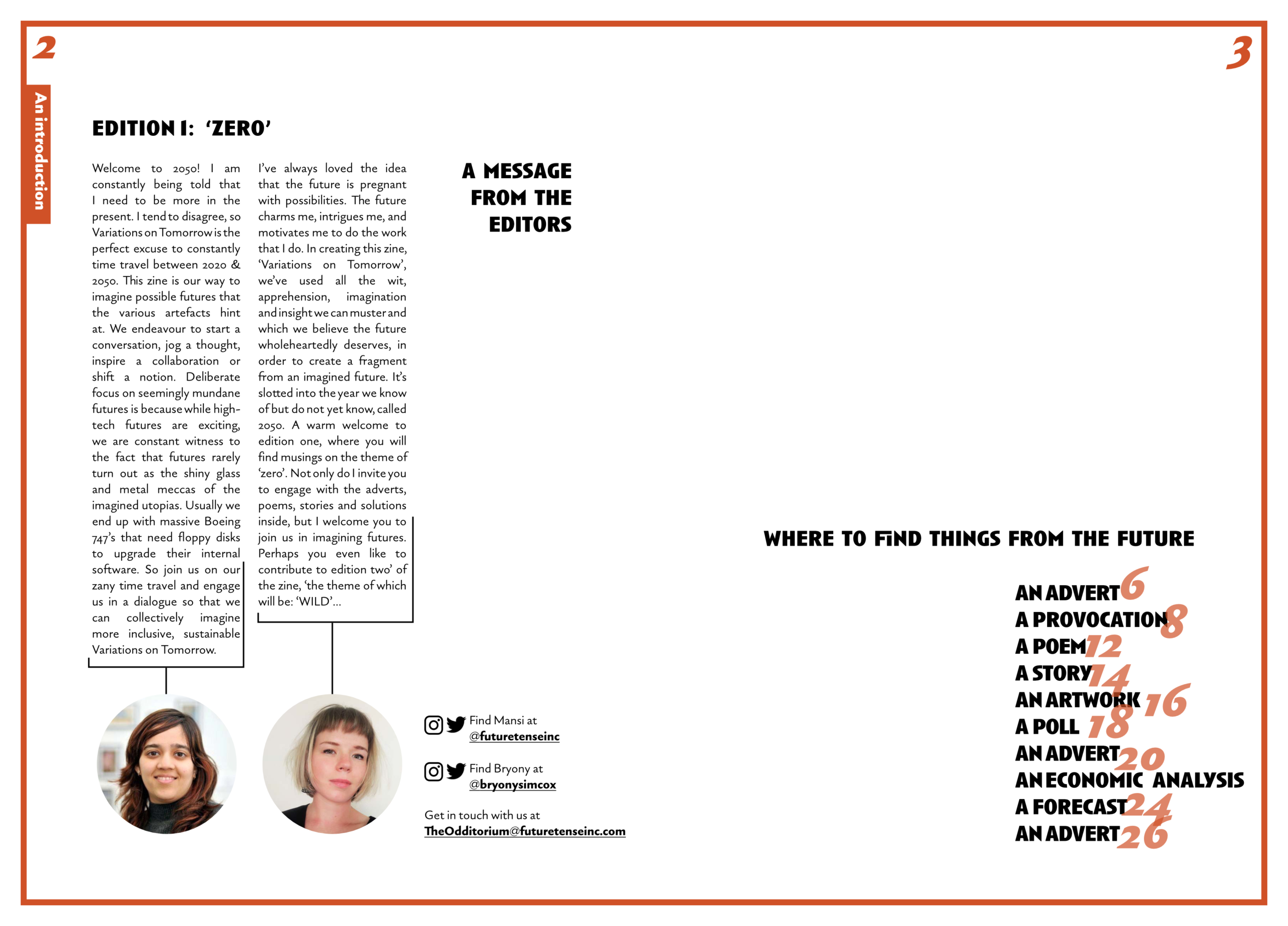
Welcome to 2050! I am constantly being told that I need to be more in the present. I tend to disagree, so Variations on Tomorrow is the perfect excuse to constantly time travel between 2020 &
2050. This zine is our way to imagine possible futures that the various artefacts hint at. We endeavour to start a conversation, jog a thought, inspire a collaboration or shift a notion. Deliberate focus on seemingly mundane futures is because while high-tech futures are exciting, we are constant witness to the fact that futures rarely turn out as the shiny glass and metal meccas of the imagined utopias. Usually we end up with massive Boeing 747’s that need floppy disks to upgrade their internal software. So join us on our zany time travel and engage us in a dialogue so that we can collectively imagine more inclusive, sustainable Variations on Tomorrow.


I’ve always loved the idea that the future is pregnant with possibilities. The future charms me, intrigues me, and motivates me to do the work that I do. In creating this zine, ‘Variations on Tomorrow’, we’ve used all the wit, apprehension, imagination and insight we can muster and which we believe the future wholeheartedly deserves, in order to create a fragment from an imagined future. It’s slotted into the year we know of but do not yet know, called 2050. A warm welcome to edition one, where you will find musings on the theme of ‘zero’. Not only do I invite you to engage with the adverts, poems, stories and solutions inside, but I welcome you to join us in imagining futures. Perhaps you even like to contribute to edition two’ of the zine, ‘the theme of which will be: ‘WILD’…

A Message
From The
Editors
Where To Find Things From The Future
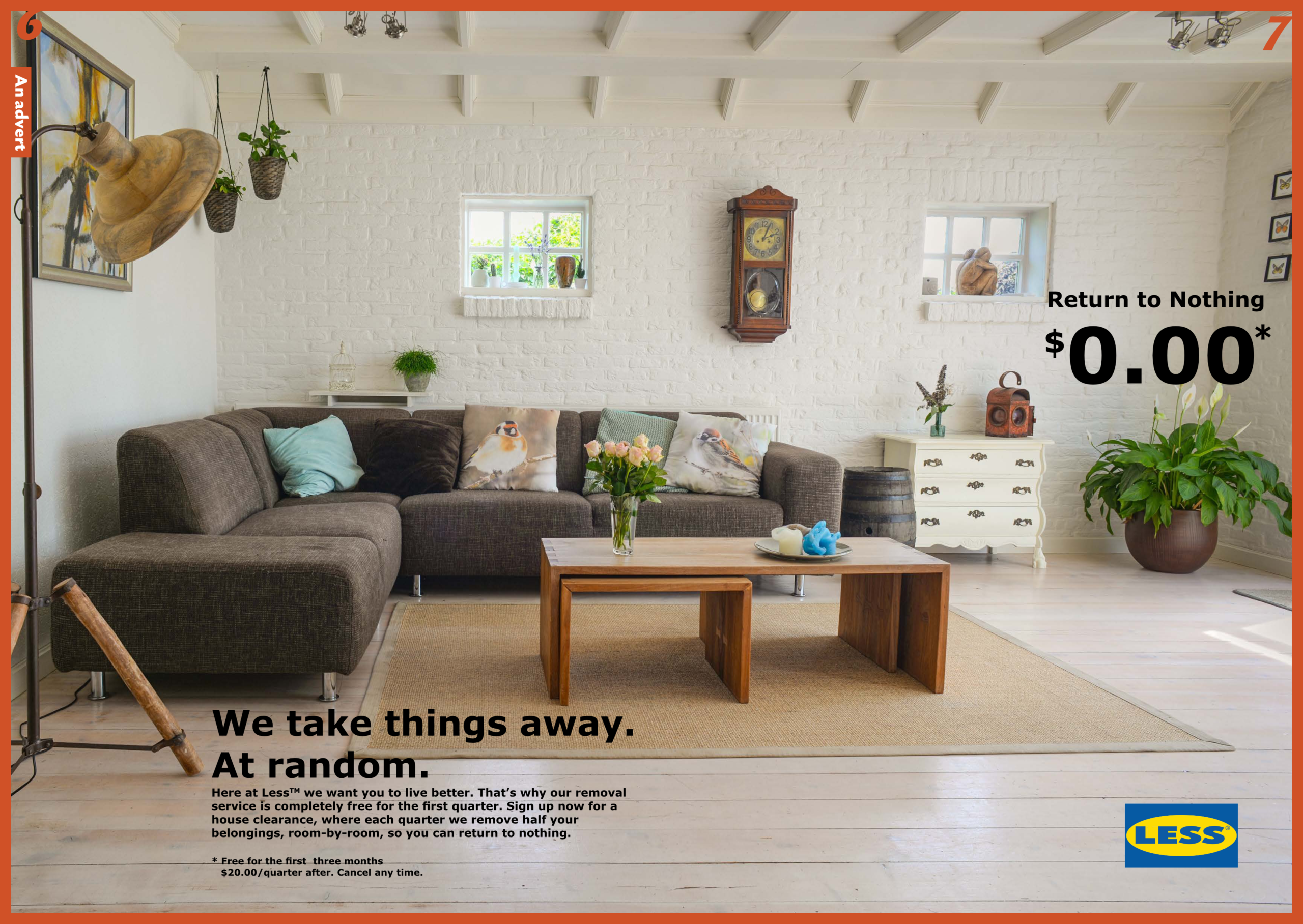
AN ADVERT
A PROVOCATION
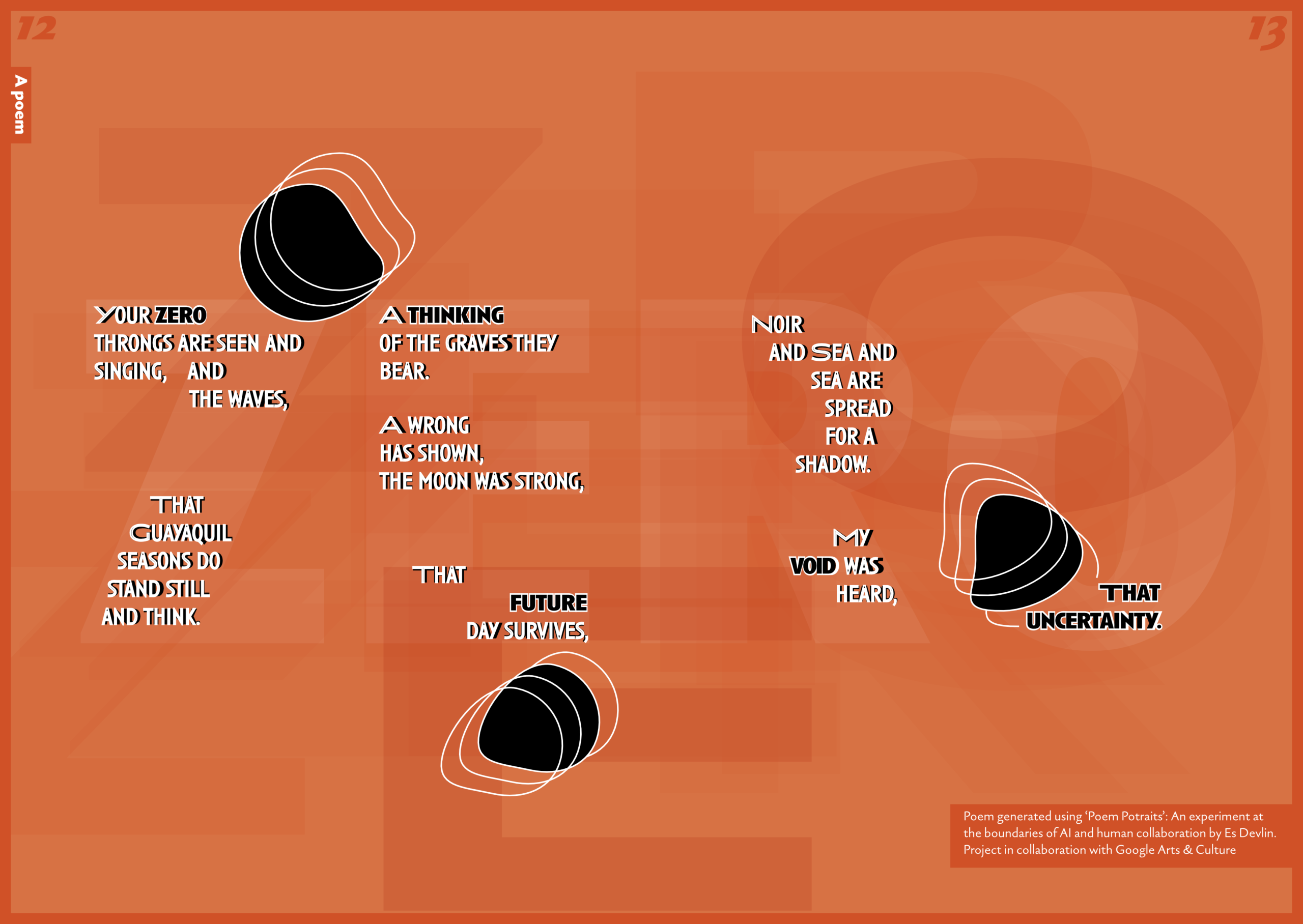
A POEM
A STORY
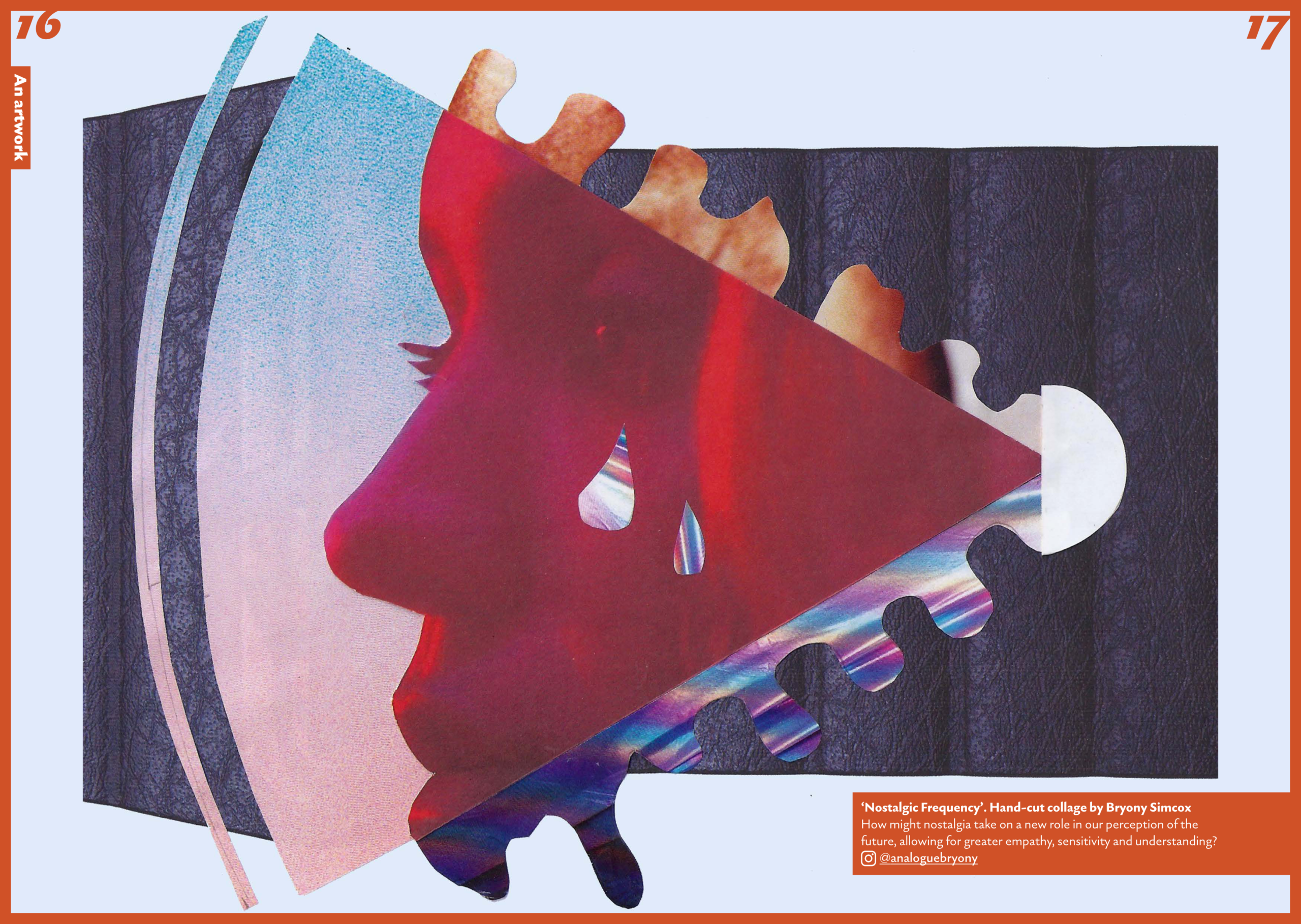
AN ARTWORK
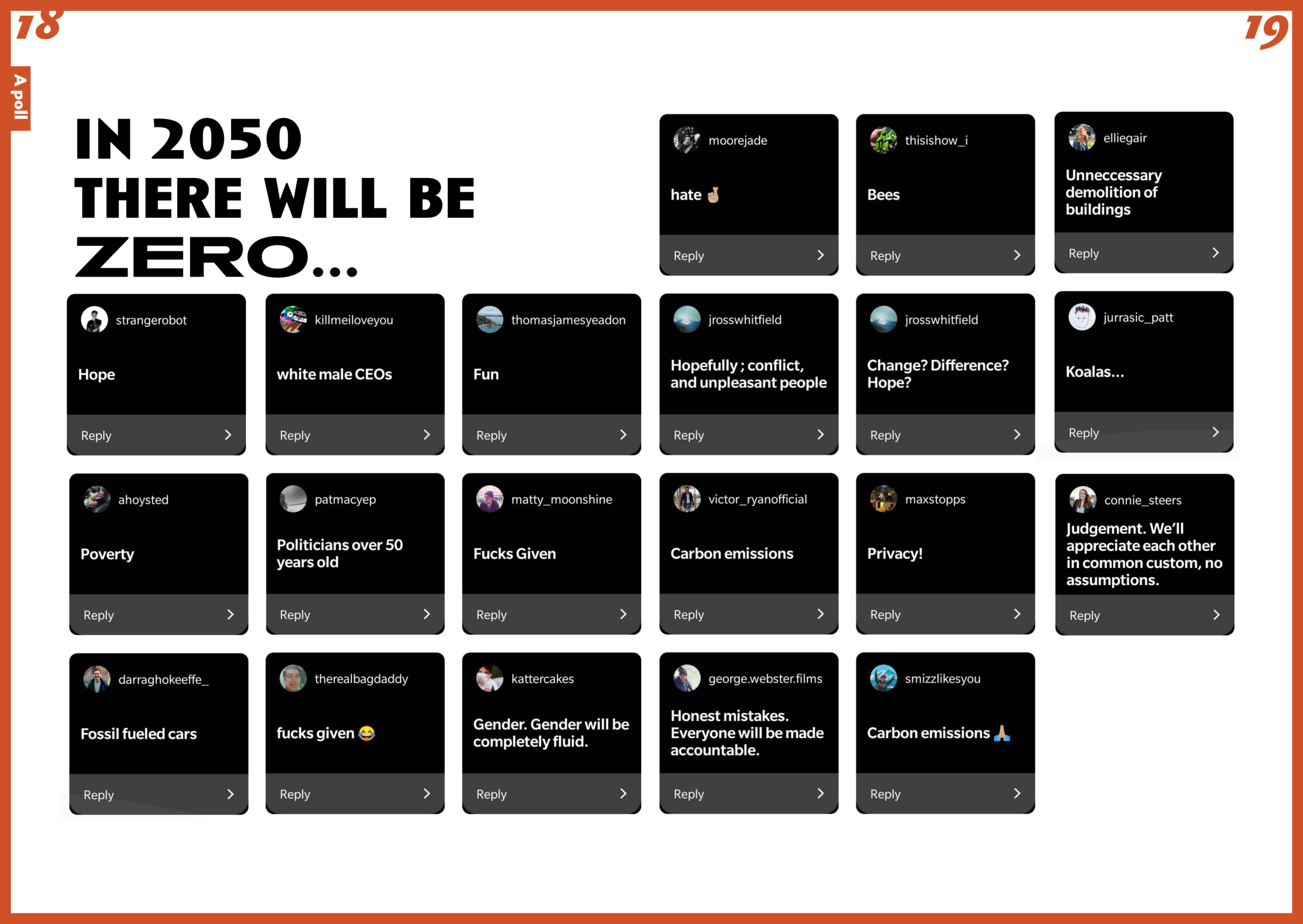
A POLL
AN ADVERT
AN ECONOMIC ANALYSIS
A FORECAST
AN ADVERT
SET IN
THE YEAR 2050,
THIS ZINE
PRESENTS
VARIATIONS
POSSIBILITIES
OF MYRIAD
ON
TOMORROW
TO EXPLORE THE
FUTURES…
A Provocation
The
Global
Pause
Button
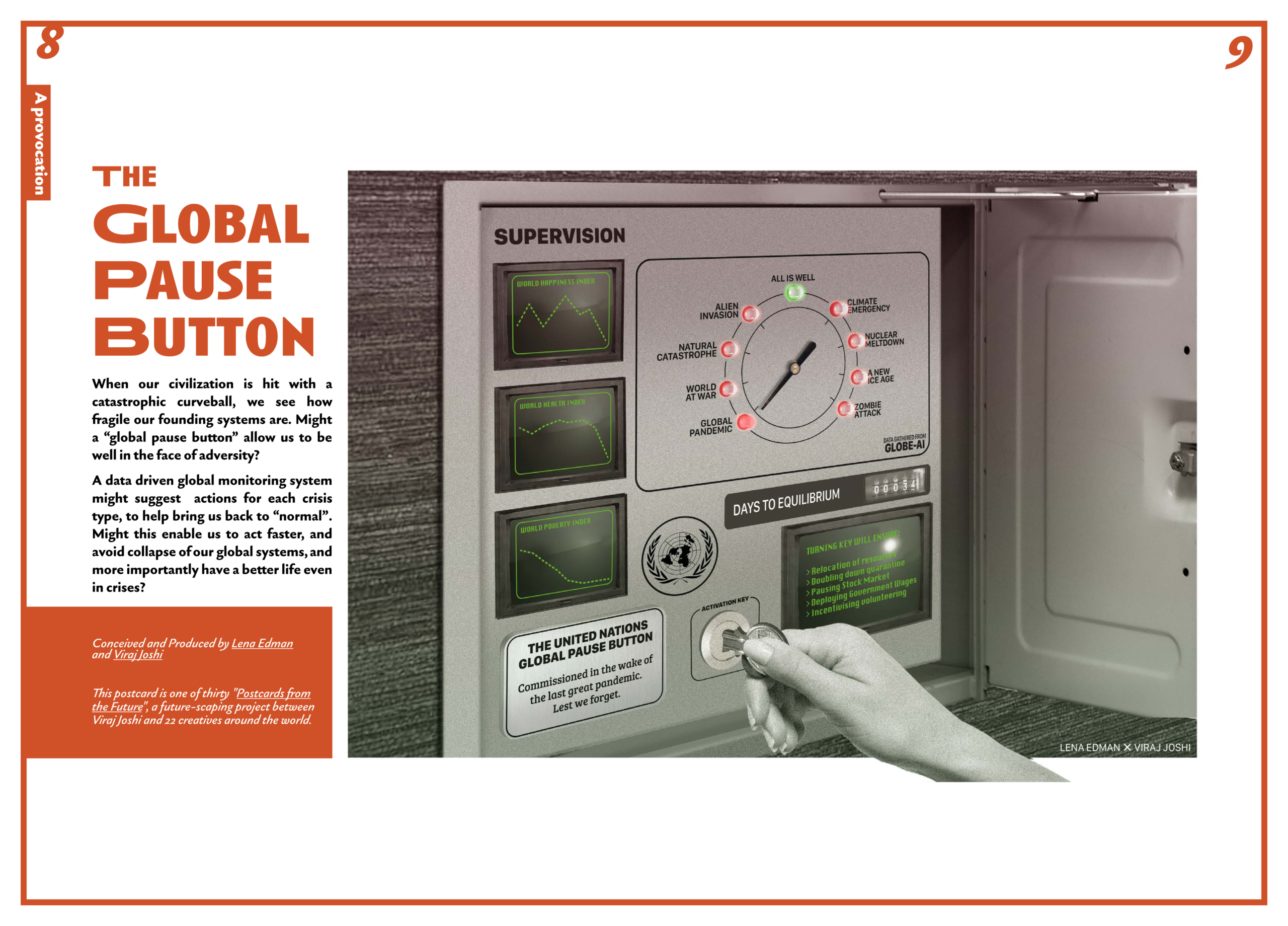
When our civilization is hit with a catastrophic curveball, we see how fragile our founding systems are. Might a “global pause button” allow us to be well in the face of adversity? A data driven global monitoring system might suggest actions for each crisis type, to help bring us back to “normal”. Might this enable us to act faster, and avoid collapse of our global systems, and more importantly have a better life even in crises?
Conceived and Produced by Lena Edman and Viraj Joshi
This postcard is one of thirty “Postcards from the Future”, a future-scaping project between Viraj Joshi and 22 creatives around the world
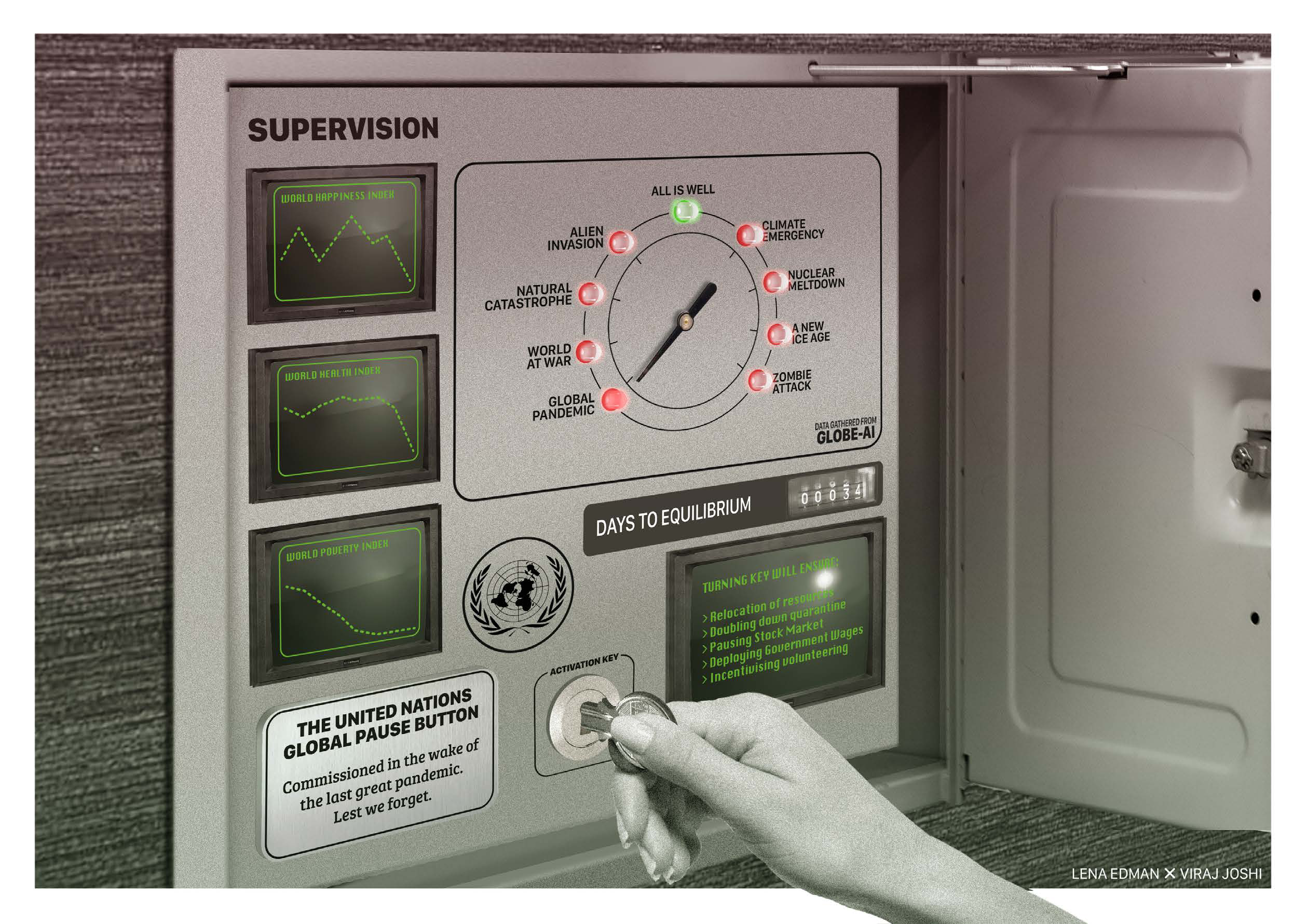
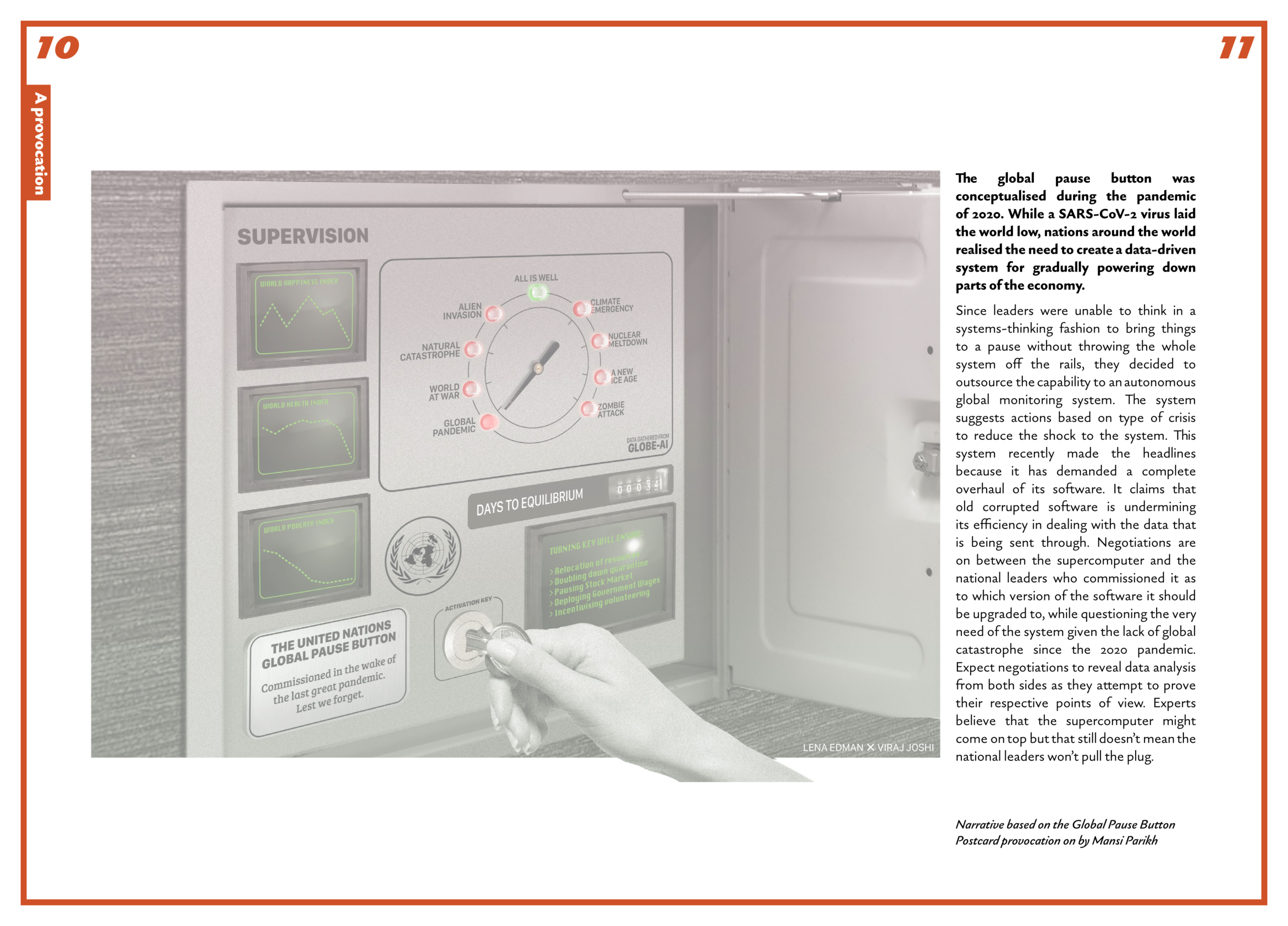
The global pause button was conceptualised during the pandemic of 2020. While a SARS-CoV-2 virus laid the world low, nations around the world realised the need to create a data-driven system for gradually powering down parts of the economy.
Since leaders were unable to think in a systems-thinking fashion to bring things to a pause without throwing the whole system off the rails, they decided to outsource the capability to an autonomous global monitoring system. The system suggests actions based on type of crisis to reduce the shock to the system. This system recently made the headlines because it has demanded a complete overhaul of its software. It claims that old corrupted software is undermining its efficiency in dealing with the data that is being sent through. Negotiations are on between the supercomputer and the national leaders who commissioned it as to which version of the software it should be upgraded to, while questioning the very need of the system given the lack of global catastrophe since the 2020 pandemic.
Expect negotiations to reveal data analysis
from both sides as they attempt to prove
their respective points of view. Experts
believe that the supercomputer might
come on top but that still doesn’t mean the
national leaders won’t pull the plug.
Narrative based on the Global Pause Button Postcard provocation by Mansi Parikh
A Story
Fifteen
Million
Credits
This weekend I was on a mission to
get my cupboard drawer unstuck.
I jiggled it a bit, and slid to the left
and to the right to no avail. In a fit
of desperation I yanked the whole
thing and out flew a little piece of
fabric and metal that jammed the
drawer
I recognised this little piece of fabric as a pouch that belonged to my grandmother, one she gave me when I was little. Opening the pouch revealed pieces of paper with a queen’s face on them. These little anachronisms were paper currency. It has been such a long while since I have seen any that I almost didn’t recognise them.
Paper money and standardised currency has been non-existent almost since I was a child. The depiction and perception of value has shifted significantly since then. Trying to not get distracted by my discovery, I quickly cleaned up the cupboard and shoved everything back in so that I could get started on my errands for the day.
Now as I walk to the neighbourhood grocery store with a large box of produce from my garden, my mind wanders back to the currency notes I found. I begin to think of how strange my life today might sound to someone from the time when paper currency was the only form of exchanging value (in my mind I refer to it as paper time).
As I entered the grocery store and placed my produce box at the drop off desk I realised that someone from paper time might think that I was a supplier to the store, and they would only be partially right. What I am doing is exchanging fresh produce from my personal garden for grocery credits which I can use in the grocery store to buy other supplies I may need from the store. I also drop off some of the seeds from my variety of plants for extra local credits which I can spend in other local stores and standalone businesses.
My favourite part about this exchange is that the seeds will be planted in the community garden – the produce from which goes mainly to the underprivileged families and to the local community shelters for food preparation at low or no cost.
A similar exchange system is available across the city through various stores, and while not all stores have adopted this mutually beneficial credits exchange system I prefer to patronise stores which do have it.
As I finish running my errands I end up with extra grocery & local credits which I am not certain I will end up using. On reaching home I open up my credit balance and troll the credit exchanges for the best exchange rates to purchase the video game credits I can use to buy the latest edition of my favourite games. I also realise that I will need health credits for my health check up next week. I quickly make the exchanges and also snap up some collector’s credits at low rates to save up for the vintage books I am looking to add to my collection.
My mind turns back to the paper currency I found and I think of the various forms of currency that have cropped up since large swathes of population around the world began losing faith in the poorly managed global financial systems. The increased fluctuations caused by climate change and associated disasters caused many to rethink how they assign value.
The new systems are not perfect by any stretch, and in fact we are still learning about the edges of these multiple avenues of value. Some of the darker edges are leading people to exchange genetic material with pharmaceutical companies so that they can develop the latest drug or therapy. People with specific genetic mutations are profiting off this practice greatly, almost reminiscent of the old Cryptokitties video game that took the world by storm in the mid-2010s.
This behaviour has spawned a rather strange
industry of genetically complementary dating
and mating.
Another more positive side of this shift in value has been the ability to control and monitor the money you spend. I remember my parents telling me to be careful of how I spent money growing up because in their younger years their spending habits became more wasteful as money changed from paper to digital, and the digital currency gamified purchase and hid the true value being spent. I however, grew up with digital currency and cards which allow me to control how many credits of each kind I spend. It keeps a check on my purchase habits as well as giving me a moment to reflect on
the purchases that I do make.
I recognise that we are in the midst of significant change, and I have heard about the extreme new credit systems the rise:
Feelers – Digital purchase mediums in the form of cards, apps or embedded chips which gauge your current mood to indicate purchases you should make.
Lucky Cats – Digital currencies which act like the luck of the draw. Rapidly changing value as the credits are bought and sold, every time you make a purchase the value available is equivalent to the luck of the draw.
Chances – A new credit system for those who crave a little bit of a gamble. Every time you make a purchase you cast a die which will decide whether or not you are able to make the purchase at that moment.
Finding these old currency notes has me thinking about where we put value and how we calculate it. While traditional monetary systems are approaching zero value, it does make me think about whether at its heart our current parallel “credits” economy is actually any different from the way previous generations placed value in paper money? Which side of the thin line between creation & destruction of value are we? And most importantly what am I going to do with those notes? I guess I can always hang on to them for the memories or trade them away for some more valuable specialised credits. We’ll see…
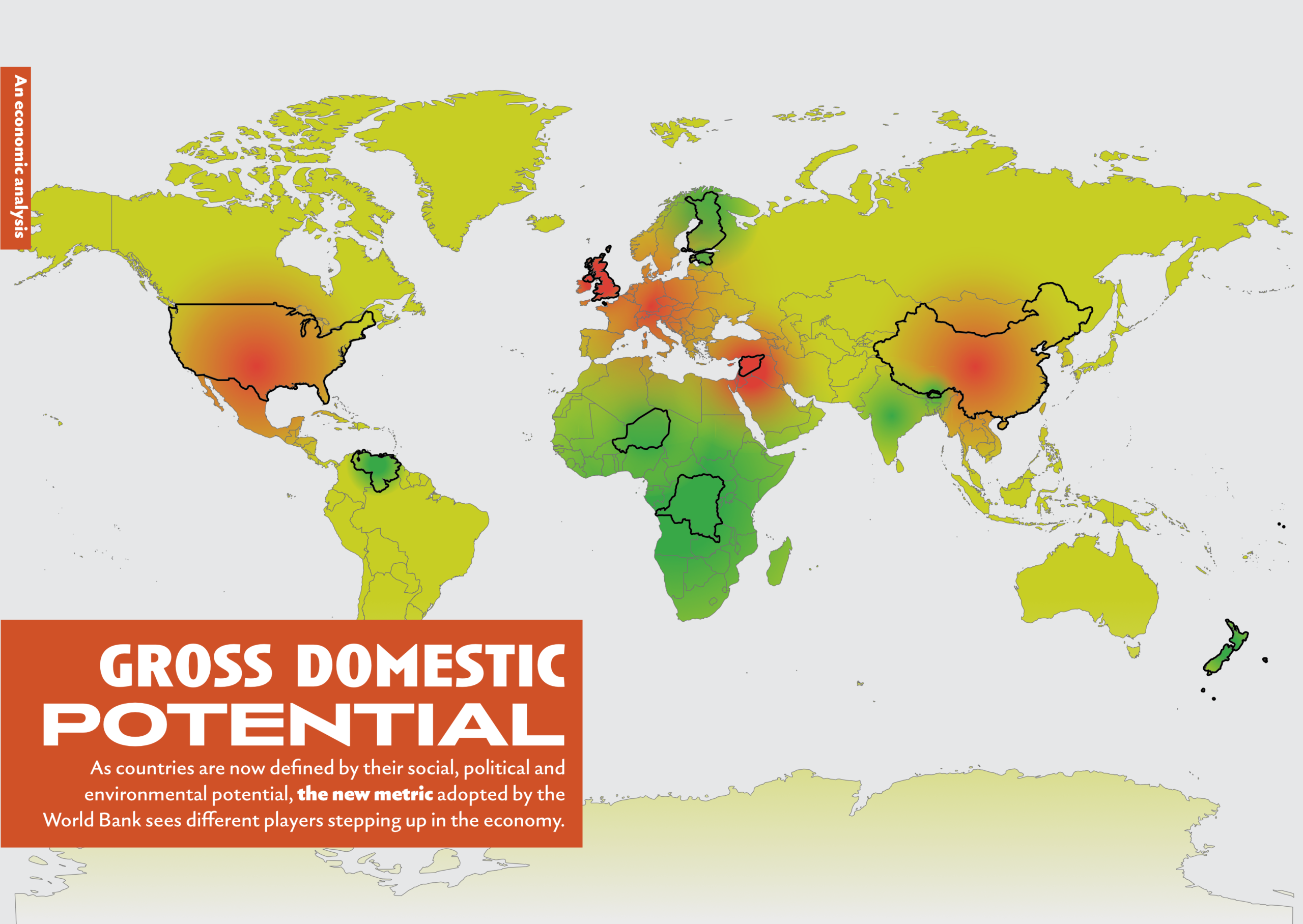
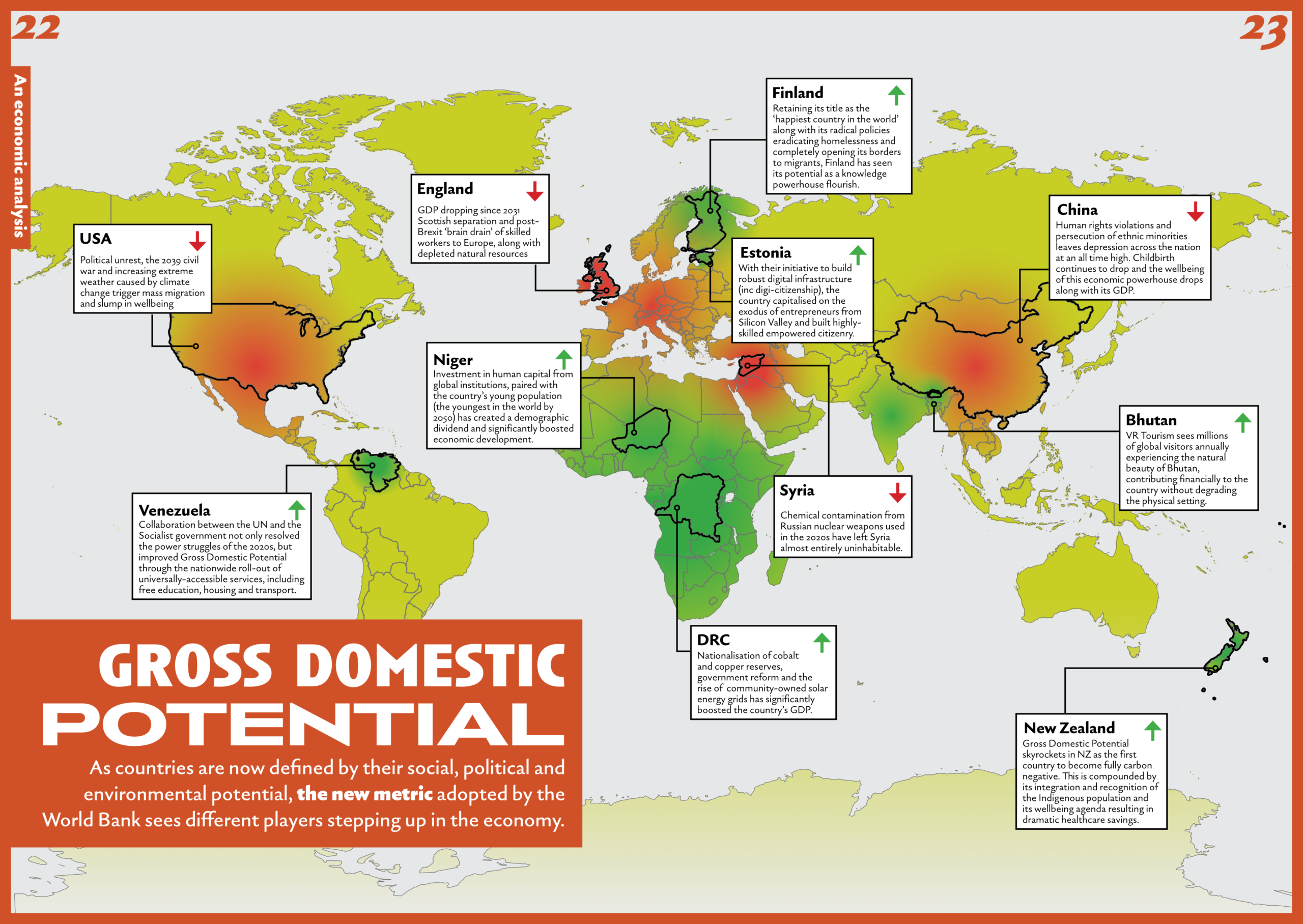
CHINA: Human rights violations and persecution of ethnic minorities leaves depression across the nation at an all time high. Childbirth continues to drop and the wellbeing of this economic powerhouse drops along with its GDP. Gross Domestic Potential skyrockets in NZ as the first country to become fully carbon negative. This is compounded by its integration and recognition of the Indigenous population and its wellbeing agenda resulting in dramatic healthcare savings.
BHUTAN: VR Tourism sees millions of global visitors annually experiencing the natural beauty of Bhutan, contributing financially to the country without degrading the physical setting.
NEW ZEALAND: Gross Domestic Potential skyrockets in NZ as the first country to become fully carbon negative. This is compounded by its integration and recognition of the Indigenous population and its wellbeing agenda resulting in dramatic healthcare savings.
SYRIA: Chemical contamination from Russian nuclear weapons used in the 2020s have left Syria almost entirely uninhabitable.
DRC: Nationalisation of cobalt and copper reserves, government reform and the rise of community-owned solar energy grids has significantly boosted the country’s GDP.
NIGER: Investment in human capital from global institutions, paired with the country’s young population (the youngest in the world by 2050) has created a demographic dividend and significantly boosted economic development.
FINLAND: Retaining its title as the ‘happiest country in the world’ along with its radical policies eradicating homelessness and completely opening its borders to migrants, Finland has seen its potential as a knowledge powerhouse flourish.
ENGLAND: GDP dropping since 2031 Scottish separation and post Brexit ‘brain drain’ of skilled workers to Europe, along with depleted natural resources.
VENEZUELA: Collaboration between the UN and the Socialist government not only resolved the power struggles of the 2020s, but improved Gross Domestic Potential through the nationwide roll-out of universally-accessible services, including
USA: Political unrest, the 2039 civil war and increasing extreme weather caused by climate change trigger mass migration and slump in wellbeing



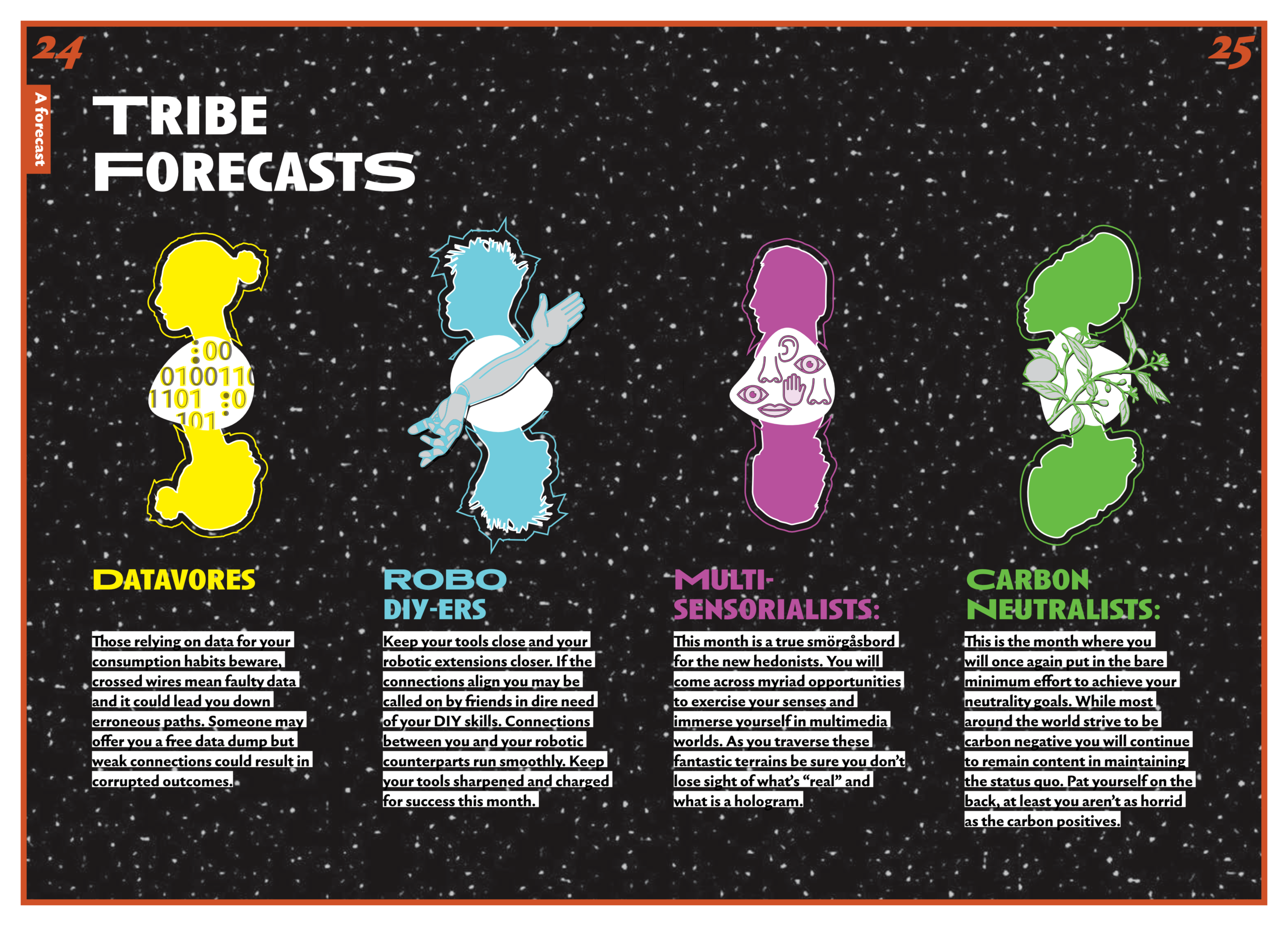
DATAVORES
Those relying on data for your consumption
habits beware, crossed wires mean faulty
data and it could lead you down erroneous
paths. Someone may offer you a free data
dump but weak connections could result in
corrupted outcomes.
ROBO DIY-ERS
Keep your tools close and your robotic
extensions closer. If the connections align
you may be called on by friends in dire
need of your DIY skills. Connections
between you and your robotic counterparts
run smoothly. Keep your tools sharpened
and charged for success this month.
MULTI-
SENSORIALISTS
This month is a true smörgåsbord for
the new hedonists. You will come across
myriad opportunities to exercise your
senses and immerse yourself in multimedia
worlds. As you traverse these fantastic
terrains be sure you don’t lose sight of
what’s “real” and what is a hologram.
CARBON NEUTRALISTS
This is the month where you will once again
put in the bare minimum effort to achieve
your neutrality goals. While most around the
world strive to be carbon negative you will
continue to remain content in maintaining the
status quo. Pat yourself on the back, at least
you aren’t as horrid as the carbon positives.
‘Variations on Tomorrow’ is a FUTURE TENSE INC. publication. This edition was edited by Mansi Parikh and Bryony Simcox
This edition’s contributors: Lena Edman and Viraj Joshi
You can find Mansi doing futures thinking at
www.futuretenseinc.com
You can find Bryony making films and telling stories at
https://broaden.studio/
The theme for the next edition is WILD. We look forward to contributions in the form of stories, artwork, design fiction artefacts, or any other creation that comes to mind. Get involved and get in touch at TheOdditoirum<at>futuretenseinc.com or on Instagram @futuretenseinc